Beyond Barbarossa: The Eastern Front of World War 2
This top-10 English-language World War 2 history podcast — the first in the world to focus on the full story of the Eastern Front — is now hosted on Acast. Visit Beyond Barbarossa for access, or find it on any podcasting app.







Episodes

Apr 6, 2026
Apr 6, 2026
28 min
"From the moment Stalin heard that the Americans were across the Rhine, he knew that the race for Berlin was on.”—Antony Beevor.
WIth the Allies on the Elbe, and the Red Army on the Oder, nazi Germany was being terminally squeezed by April 1945. But before they can drive on the prize, Berlin, the Red Army must take Vienna.
Map 1: The Red Army’s advance, 1944–1945
Map 2: The Red Army on the Oder and Niesse
Map 3: Advance into Vienna
Map 4a: European front line, 1 April 1945
Map 4b: European front line, 15 April 1945
Historical photos
Georgy Zhukov, Marshal of 1st Belorussian Front
Ivan Konev, Marshal, 1st Ukrainian Front
Rodion Malinovsky, Marshal, 2nd Ukrainian Front
Fyodor Tolbukhin, Marshal, 3rd Ukrainian Front
Mar 23, 2026
Mar 23, 2026
41 min
The #6 Top World War 2 podcast continues following the Red Army’s advance into Hungary and Germany—and the expensive failure of the German Operation Spring Awakening.
Map 1: Front lines in Europe, 1 March 1945
Map 2: Operation Southwind/Sudwind
Map 3a: German plans for Operation Spring Awakening
Map 4: The Soviet counter-attack, The Lake Balaton counter-offensive
Map 5: Following Operation Spring Awakening
Map 6: Upper Silesian locations in 2026
Map 7: The front lines, Europe, 1 April 1945
People
Rodion Malinovsky
Fyodor Tolbukhin
Heinz Guderian
Friedrich Schorner
Walther Nehring (right)

Mar 9, 2026
Mar 9, 2026
36 min
The Red Army penetrates deep into Germany, leading to the redrawing of eastern European borders after.
Map 1: The Oder offensive–March 1945
Map 2: The Lower Silesian Offensive
Map 3: The East Pomeranian Offensive
Map 4a: European fronts, 15 February 1945
Map 4b: European fronts, 15 March 1945
Photos
Marshal Ivan Konev, Commander of the 1st Ukrainian Front
General Walther Wencke, chief of staff, Army Group Vistula, February 1945
Child soldiers in the wehrmacht: Hitler Youth in Breslau (Wroclaw), February 1945
Breslau (Wroclaw) in fighting, 1945

Feb 23, 2026
Feb 23, 2026
42 min
Why did the Yalta Conference end the way it did? Why did Churchill try an end-run around Roosevelt? Why did Roosevelt try to curry Stalin’s favour? What would this mean to post-war history?
Author Giles Milton joins to discuss some of the Second World War’s most perplexing questions.
People
Author Giles Milton
His latest book, The Stalin Affair: The impossible alliance that won the war
The Big Three: Soviet Premier Josef Stalin, U.S. President Franklin Delano Roosevelt, and U.K. Prime Minister Winston Churchill
Kathleen “Kathy” or “Puff” Harriman, daughter of Roosevelt’s right hand and Ambassador to the USSR in 1945, Averell Harriman
Averell Harriman
Pamela Churchill, WInston Churchill’s daughter-in-law in 1945, and later, Mrs. Averell Harriman
Stalin and Churchill at the Moscow Conference, 1944
Franklin Roosevelt in 1945
Map 1: The division of Germany after May 1945
Map 2: Invasion of Poland, 1939
Map 3: Poland moves 100 km west
Sources
Giles Milton, author: https://www.gilesmilton.com/
Books
podcast: Ministry of Secrets

Feb 16, 2026
Feb 16, 2026
33 min
Why were the Yalta Conference’s decisions so vague? Why did Stalin get everything he wanted? And why did Roosevelt act so naively?
Giles Milton, bestselling author of The Stalin Affair: The Impossible Alliance that Won the War, joins the podcast today to help understand the relationships that had the greatest impact on the second meeting of the Big Three of the Second World War.
Photos
Author Giles Milton
The Stalin Affair: The Impossible Alliance that Won the War by Giles Milton
The Big Three at Yalta, February 1945. Roosevelt would be dead in two months.
Map 1: Yalta in Crimea, on the Black Sea, site of the 1945 Yalta Conference of the Big Three
Map 2: The tortured road from Saky Airfield to Yalta
Sources
Giles Milton, author: https://www.gilesmilton.com/
Books
podcast: Ministry of Secrets

Feb 2, 2026
Feb 2, 2026
42 min
Winston Churchill and Franklin Roosevelt meet in Malta in the Mediterranean in February 1945, to prepare to meet Josef Stalin in the second Big Three conference on Soviet territory—Yalta.
It was a meeting that shaped the world for decades.
Map 1: Malta to Yalta
Map 2: The Western Front, 1 February 1945
Map 3: The Pacific Theatre, 1 February 1945
Map 4: Poland’s shift west, 1945
Photos
Left: Franklin Roosevelt in 1944. Right: Roosevelt and Churchill at Malta, 2 February 1945.
Averell Harriman and daughter Kathleen
The Vorontsov Palace, quarters for the British delegation
The Livadia Palace, quarters for the American delegation
The Yusupov Palace, housing the Soviet delegation
Jan 19, 2026
Jan 19, 2026
44 min
The Red Army continues its continual advance onto German soil—and the flight of German civilians and military.
Map 1: The siege of Kongisberg
Map 2: Samland
The Samland Peninsula in 1905, showing city and town names still present in 1945.
Map 3: The (second) East Prussian Offensive
Map 4: The advance across Poland
Historical photos
Franklin Roosevelt meets Winston Churchill in Malta, 2 February 1945
Civilians from Konigsberg walk across frozen Vistula Lagoon, January 1945
CIvilians flee Lodz, Poland, January 1945
Red Army arrives in Lodz, Poland, January 1945
Hitler shakes hands with Col. Claus von Stauffenberg at the “Wolf’s Lair," July 1944.
Ruins of the Wolfsschanze, “Wolf’s Lair,” Hitler’s headquarters in East Prussia
Sources
Antony Beevor, The Second World War. New York, NY, USA: Little, Brown and Company, 2012.
Scott Bury, Walking Out of War: Volume 3 of the Eastern Front Trilogy. Ottawa, Canada: The Written Word, 2017.
Evan Mawdsley, Thunder in the East: The Nazi-Soviet War, 1941–1945. London: Bloomsbury Academic, 2016.
Anthony Tucker-Jones, Slaughter on the Eastern Front: Hitler and Stalin’s War, 1941–1945. Stroud, Gloucestershire, UK: The History Press, 2017.
David Sumner, Europe at War: A podcast about lesser-known battles of the Second World War. https://podcasts.apple.com/ca/podcast/europe-at-war-a-ww2-podcast/id1788043665
Larysa Zariczniak, Wandering the Edge: Ukrainian history and culture https://podcasts.apple.com/ca/podcast/wandering-the-edge/id1547149262
David Sumner, Europe at War: A WW2 podcast https://podcasts.apple.com/ca/podcast/europe-at-war-a-ww2-podcast/id1788043665
Morse code by Thane Brown
Music composed and recorded by Nicolas Bury

Jan 5, 2026
Jan 5, 2026
36 min
After 10 shattering blows on the Eastern Front in 1944, the Western Allies and the USSR continue to compress nazi Germany in January 1945.
Map 1: The compressing front
1a: 1 January 1944
1b: 1 January 1945
1c: 15 January 1945
Map 2: The siege of Budapest, January 1945
Map 3: The Vistula-Oder campaign, January 1945
Map 4: The East Prussia offensive
Photos
The Budapest Chain Bridge destroyed, January 1945
Ruins of Warsaw, even in 1947
Source: New York photographer Henry N. Cobb, taken in 1947, via Rare Historical Photos.

Dec 22, 2025
Dec 22, 2025
38 min
"Budapest lay athwart the main entry route to Austria and Bohemia. It was the main railway hub of the region and also the largest Danubian port. The Red Army could not bypass it. This was the first time in the war that the Red Army had to lay siege to a major city."
The Red Army assaults the capital of nazi Germany’s final remaining partner in the Second World War. The war appears to be almost lost—but that’s seen through hindsight. No one at the time knew that.
Map 1: The Eastern Front, December 1944
Map 2: Germany’s eastern and western fronts, 1 December 1944
Map 3: The Petsamo-Kirkenes operation in northern Finland
Map 4: The Red Army attacks Budapest
Operation Konrad II
People
Mihai I, King of Romania, 1944–1947
Miklos Horthy, Regent of Hungary
Miklos Horthy Jr.
Ference Szalasi, nazi dictator of Hungary, 1944–1945
Edmund Veesenmayer, Hitler’s “Special Envoy” to Hungary, 1944–1945
SS-Obergruppenführer Karl Pfeffer-Wildenbruch, commander of IX SS Mountain Corps
Historical photos: Fighting in Budapest
Sources
Antony Beevor, The Second World War. New York, NY, USA: Little, Brown and Company, 2012.
Evan Mawdsley, Thunder in the East: The Nazi-Soviet War, 1941–1945. London: Bloomsbury Academic, 2016.
Anthony Tucker-Jones, Slaughter on the Eastern Front: Hitler and Stalin’s War, 1941–1945. Stroud, Gloucestershire, UK: The History Press, 2017.
Morse code by Thane Brown
Music composed and recorded by Nicolas Bury

Dec 8, 2025
Dec 8, 2025
40 min
There was a lot of action on the Eastern Front in the autumn of 1944. In late September, the Red Army and its new allies enter Yugoslavia and connect with communist Partisans led by a man called Tito. The results will echo across the decades.
Map 1: The Balkan military theatre, September 1944–January 1945
Map 2: The Bulgarian incursion
Map 3: The Battle of Belgrade
Photos
The Lockheed P-38 Lightning and the Focke-Wulf fw189
The Yakovlev Yak-9 in flight
The Yakovlev Yak-9 in the Russian military museum
Josip Broz, a.k.a. Tito, far right, with his staff.
Sources
Antony Beevor, The Second World War. New York, NY, USA: Little, Brown and Company, 2012.
Evan Mawdsley, Thunder in the East: The Nazi-Soviet War, 1941–1945. London: Bloomsbury Academic, 2016.
Giles Milton, The Stalin Affair: The impossible alliance that won the war. New York, NY, USA: Henry Holt and Company, 2022.
Anthony Tucker-Jones, Slaughter on the Eastern Front: Hitler and Stalin’s War, 1941–1945. Stroud, Gloucestershire, UK: The History Press, 2017.
Morse code by Thane Brown
Music composed and recorded by Nicolas Bury

Nov 24, 2025
Nov 24, 2025
34 min
In October 1944, the Red Army entered East Prussia, the heart of German militarism. Horrific war crimes ensued.
Map 1: The Red Army’s advances all across the broad front
Map 2a: European Theatre, 1 October 1944
Map 2b: European Theatre, 1 November 1944
Map 3a: The Pacific Theatre, 1 October 1944
Map 3b: The Pacific Theatre, 1 November 1944
Map 4: The Gumbinnen Operation
Historical photos
Konigsberg Castle before World War 1
German officers find evidence of massacre at Nemmersdorf, East Prussia
Civilians killed at Nemmersdorf, 1944
Sources
Antony Beevor, The Second World War. New York, NY, USA: Little, Brown and Company, 2012.
Evan Mawdsley, Thunder in the East: The Nazi-Soviet War, 1941–1945. London: Bloomsbury Academic, 2016.
Pat McTaggart, "Goldap Operation: Soviets in the Prussian Heartland,” in WWII History, vol. 14, No. 2, February 2015. Cited in Warfare History Network, February 2015, https://warfarehistorynetwork.com/article/goldap-operation-soviets-in-the-prussian-heartland/
Anthony Tucker-Jones, Slaughter on the Eastern Front: Hitler and Stalin’s War, 1941–1945. Stroud, Gloucestershire, UK: The History Press, 2017.
Morse code by Thane Brown
Music composed and recorded by Nicolas Bury

Nov 10, 2025
Nov 10, 2025
35 min
In the autumn of 1944, nation after nation abandons the cruel, insane Axis to join the Western Allies or USSR: Romania, Bulgaria, Slovkia … as Finland signs an armistice with the USSR. With the Red Army on the border of Germany itself, Hungary faces the choice: to fight on with, or against, the nazis.
Map 1: The Red Army invades Slovakia
The Dukla Pass is to the right.
Map 2: The Battle of Debrecen
Photos
General (later Marshal) Rodion Malinovsky, 1944
General (later Marshal) Fyodor Tolbukhin, 1944
Marshal Ivan Konev, 1945
Milos Horthy, Regent of Hungary, 1944
Ferenc Szalisi, Leader of the Hungarian Nation, 1944
General Heinz Guderian, Inspector-General of the Army, 1944

Oct 27, 2025
Oct 27, 2025
43 min
By the autumn of 1944, everyone could see which way the Second World War was going — even the Axis commanders. Still, they were able to hold the Red Army back in key locations like Courland and Memel.
Map 1: The Courland and Memel pockets, to the end of 1944
Map 2: The Memel pocket, 1944
Image 1: Hovhannes Bagramyan in 1955
Image 2: Army of Worn Soles, volume 1 of the Eastern Front Trilogy
https://www.amazon.com/Army-Worn-Soles-Scott-Bury/dp/0987914197/
Image 3: Walking Out of War, volume 3 of the Eastern Front Trilogy
https://www.amazon.com/gp/product/1987846052
Sources
Scott Bury, Army of Worn Soles: Volume 1 of The Eastern Front Trilogy. Ottawa: The Written Word Publishing Co., 2014.
Scott Bury, Walking Out of War: Volume 3 of The Eastern Front Trilogy. Ottawa: The Written Word Publishing Co., 2014.
Prit Buttar, The Reckoning: The Defeat of Army Group South, 1944 . Okford, UK: Osprey Publishing, 2020.
Evan Mawdsley, Thunder in the East: The Nazi-Soviet War, 1941–1945. London: Bloomsbury Academic, 2016.
Morse code by Thane Brown
Music composed and recorded by Nicolas Bury

Oct 22, 2025
Oct 22, 2025
39 min
Describing the Eastern Front chronologically gets very difficult in the second half of 1944, because there’s so much happening everywhere, all at the same time.
After the Warsaw Rising, as described in Episode 83, the Red Army surged past its borders into Finland, Estonia, Romania, Bulgaria, and farther.
Meanwhile, the Western Allies are taking France, Belgium and Italy from Hitler. But there is still a lot of fighting and death to come.
Map 1: The Gothic Line, Italy
Map 2: The Continuation War ends, Finland
Map 3: The advance of the Red Army, August 1943–December 1944
Maps 4A and 4B: Advances of the front lines, east and west
4A: 15 August 1944
4B: 1 October 1944
Sources
Antony Beevor, The Second World War. London, UK: Little, Brown and Co., 2012.
Evan Mawdsley, Thunder in the East: The Nazi-Soviet War, 1941–1945. London: Bloomsbury Academic, 2016.
Anthony Tucker-Jones, Stalin’s Revenge: Operation Bagration and the Annihilation of Army Group Centre. Barnsley, South Yorkshire, UK: Pen and Sword Books, 2009.
Morse code by Thane Brown
Music composed and recorded by Nicolas Bury

Sep 29, 2025
Sep 29, 2025
35 min
Today, Beyond Barbarossa fulfills a promised made at the start of this podcast: a meaningful donation to help refugees of Russia’s unjustifiable war of aggression against Ukraine, to the Ukraine Humanitarian Appeal.
We’re joined by Valeriy Kostyuk, Executive Director of the Canada-Ukraine Foundation, which runs the appeal.
Links
Canada-Ukraine Foundation
Ukraine Humanitarian Appeal
Medical javelins
Thornhill Medical and their MOVES SLC mobile life-support system.

Sep 15, 2025
Sep 15, 2025
48 min
In August 1944, the Red Army steamrolled across eastern Europe. Yet when Warsaw rose up against the nazi occupiers, they found themselves alone.
Historic photos
Tadeusz Bor-Komorowski (right), Commander-in-Chief of the Polish Home Army
AK fighter with flamethrower
Home Army soldiers from Kolegium "A" of Kedyw formation on Stawki Street in the Wola District of Warsaw, September 1944. Source: Wikipedia Commons
Jewish POWs freed by AK
The remains of Warsaw after the Germans “withdrew.”
Sources
Antony Beevor, The Second World War. London, UK: Little, Brown and Co., 2012.
Norman Davies, Rising ’44: The Battle for Warsaw. London, UK: Macmillan, 2004.
Evan Mawdsley, Thunder in the East: The Nazi-Soviet War, 1941–1945. London: Bloomsbury Academic, 2016.
Anthony Tucker-Jones,Slaughter on the Eastern Front: Hitler and Stalin’s War 1941–1945. Stroud, Gloucestershire, UK: The History Press, 2017.
Music by Nicolas Bury.
Morse code from Thane Brown.

Sep 5, 2025
Sep 5, 2025
50 min
In this special episode of the podcast on the Eastern Front of World War Two, we go beyond Beyond Barbarossa and beyond the end of the Second World War.
80 years ago to the day of this publication a handsome young man approached Canadian media and officials with proof that the Soviet Union was spying on its allies. The Cold War was on.
Former Soviet cypher clerk Igor Gouzenko, hooded to protect his identity, being interviewed by Associated Press reporter Saul Pett in Montreal in 1954.
The Gouzenkos’ apartment building on Somerset Street in central Ottawa. There is no plaque commemorating Igor Gouzenko. (Photo by Scott Bury, 2025.)
Igor Gouzenko in Canada, 1946.
Sources
Winston Churchill, “The Sinews of Peace,” speech given at Westminster College, Fulton, Missouri, U.S.A., 5 March 1946. https://www.americanrhetoric.com/speeches/winstonchurchillsinewsofpeace.htm
J.L. Granatstein and David Stafford, Spy Wars: Espionage and Canada from Gouzenko to Glasnost. Toronto: Key Porter Books, 1990.
John Sawatsky, Gouzenko: The Untold Story. Toronto: Macmillan of Canada, 1984
Wikipedia, Gouzenko Affair. https://en.wikipedia.org/wiki/Gouzenko_Affair
Wondery Podcasts, “The Spy Who, Season 7: The Spy Who Started the Cold War” https://wondery.com/shows/the-spy-who/season/7/

Aug 25, 2025
Aug 25, 2025
23 min
In summer 1944, "the Red Army’s seemingly unstoppable streamroller took Stanislav in the Carpathian foothills, Bialystok in northern Poland, Dvinsk in Latvia and the Siauliai (also spelt Shaulyai) rail junction between Riga and East Prussia.” — Anthony Tucker-Jones.
Even so, the steamroller suffered ferocious mauling.
If you can transcribe the morse code signal during “What else is happening in the war,” send an email to scott@beyondbarbarossa.ca. If you’re correct, I will send you a free autographed copy of The Eastern Front Trilogy.
Map 1a: The Eastern Front, July 1944
Map 1b: The front, August 1944
Map 2: The Lvov-Sandomierz Offensive, detail
Map 3: The Narva Offensive
Music by Nicolas Bury.
Morse code from Thane Brown.
Some sound effects from Zapsplat.com.

Aug 11, 2025
Aug 11, 2025
34 min
Stalin’s one-two punch against Germany is the Lvov-Sandomierz offensive, hitting in Ukraine as Bagration smashes into Byelorussia. It also lays bare the brutality within the Red Army.
Map 1: The Byelorussian Balcony
Map 2: The Lvov-Sandomierz Operation
Map 3: The Eastern Front, 15 June 1944
Map 4: The Eastern Front, 15 July 1944
Map 5: The Eastern Front, 15 August 1944
Ivan Konev, commander, 1st Ukrainian Front
Lt. General Pavel Rybalko, commander, 3rd Guards Tank Army
Josef Harpe, Commander, Army Group North Ukraine
Sources:
Antony Beevor, The Second World War. London, UK: Little, Brown and Co., 2012.
Prit Buttar, Retribution: The Soviet Reconquest of Central Ukraine, 1943. Oxford, UK: Osprey Publishing, 2019.
Evan Mawdsley, Thunder in the East: The Nazi-Soviet War, 1941–1945. London: Bloomsbury Academic, 2016.
Anthony Tucker-Jones, Stalin’s Revenge: Operation Bagration and the Annihilation of Army Group Centre. Barnsley, South Yorkshire, UK: Pen and Sword Books, 2009.
Jul 7, 2025
Jul 7, 2025
55 min
Did the Lend-Lease program save the Soviet Union? For the Season 3 finale, Angus Wallace of the World War 2 podcast joins to offer a nuanced interpretation.
Angus Wallace, host and producer of The World War 2 podcast
The Lend-Lease Act
British Valentine tanks to be sent to USSR under Lend-Lease, 1942.
The Bell P-39 Aircobra, one of the fighters the U.S. sent to the Soviet Union under Lend-Lease.
A Hawker Hurricane fighter sent for the Red Air Force.
Fleets of Studebaker, Ford and Chevrolet trucks sent to the Soviet Union under Lend-Lease.
U.S. jeeps sent to the Soviet Union under Lend-Lease made Life magazine.
The Western Allies sent millions of tons of food aid to the Soviet Union during World War 2.
The Red Army moved tanks to the front by rail, on flatcars, with locomotives often supplied by the U.S. Much of the rail was also supplied by the U.S.
The “Big Three,” Churchill, Roosevelt and Stalin, at the Yalta Conference in 1945. Roosevelt was clearly unwell by this point. This conference decided the post-war division of Europe between West and East, meaning USSR.
Maps
Map 1: Lend-Lease shipping routes
Lend-Lease shipping literally spanned the globe.
Map 2: The Arctic route (polar projection)
Map 3: The Persian Corridor.
Ships arrived in Persian Gulf ports, then goods were transshipped by train through Iran to be loaded onto ships again at the Caspian Sea.
Map 4: The Pacific route.
Note the proximity to Japan as ships approach Vladivostok in the Russian Far East.
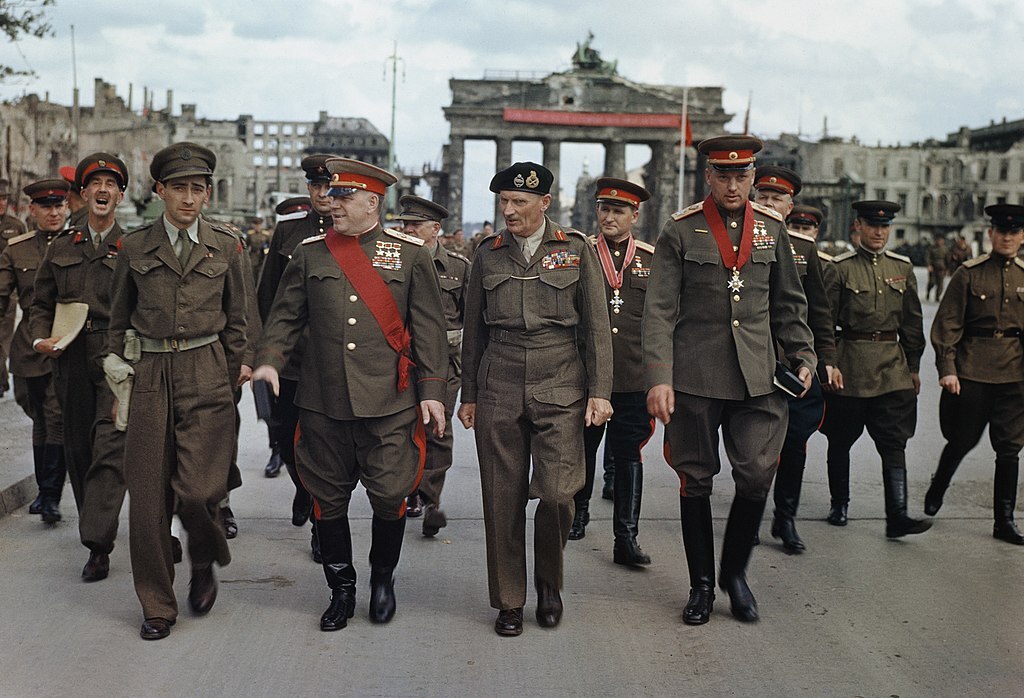
Bonus series: Georgy Zhukov
A series for Beyond Barbarossa patrons and supporters: a profile of Marshal Georgy Zhukov, the greatest general of the USSR in World War II.
Episode 6: Germany ... triumphant?
We focus on the progress of German Army Group Centre to Smolensk in July 1941.
This episode sponsored by The Eastern Front Trilogy, the true story of a Canadian drafted into the Red Army in World War II.
All proceeds from the sales of The Eastern Front Trilogy in paperback or its constituent e-books will go to helping Ukrainian refugees until all Ukrainians can return home safe from Russian military aggression.
Contact the author by email to contact@writtenword.ca
Support the podcast on Patreon.
Books cited in this episode:
David Glantz: Operation Barbarossa: Hitler's Invasion of Russia 1941. Stroud, Gloucetershire, UK, 2011.
David Stahel: Operation Barbarossa and Germany's Defeat in the East. Cambridge, UK: Cambridge University Press, 2009.
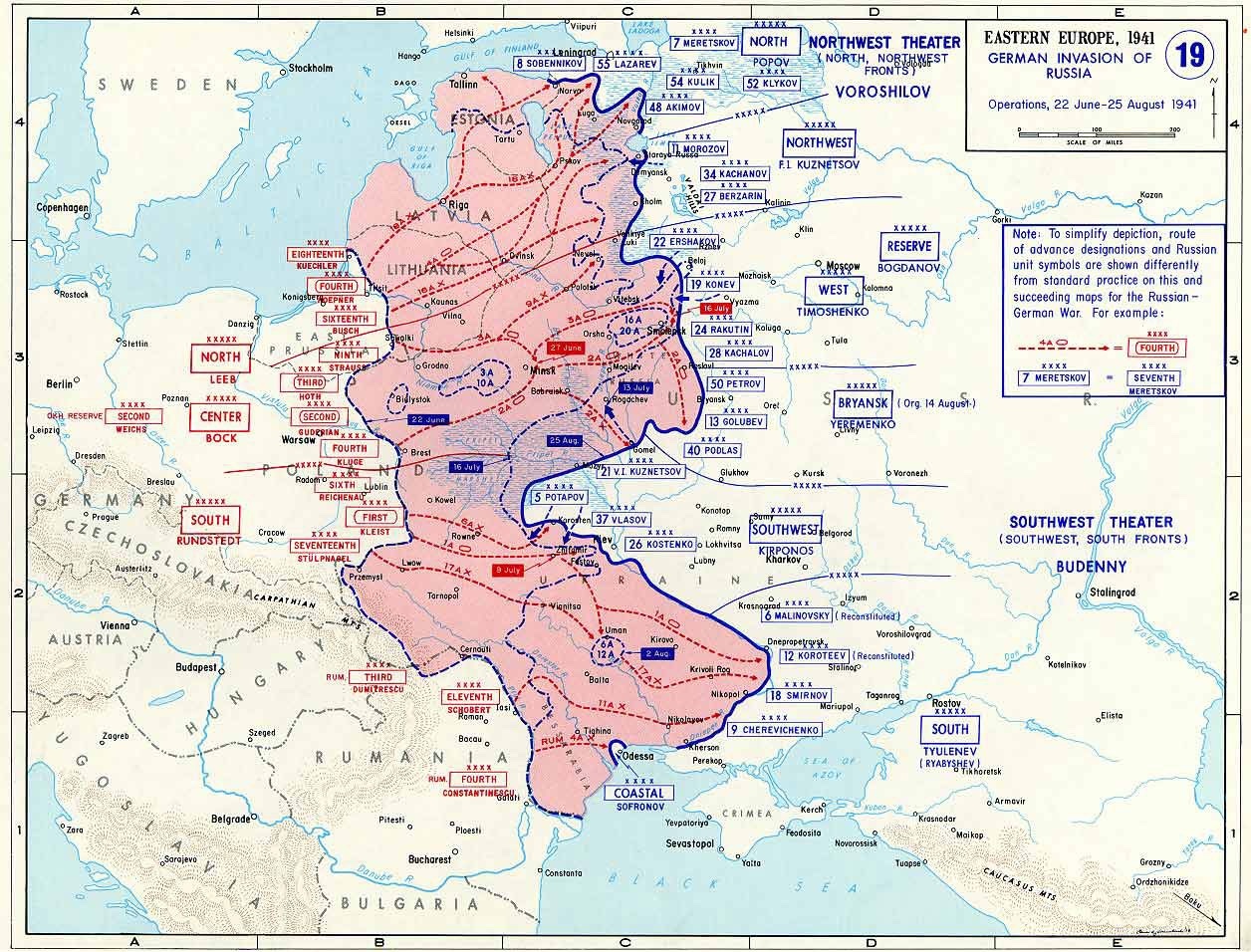
Map 1: the situation in the summer of 1941.
The pink area shows the depth of the invasion from June 22 to August 25. The dashed blue line through it shows the approximate position of the front line on July 16.
Note the encirclements at Bialystock, west of Minsk, at Smolensk, and in Ukraine, around Uman.
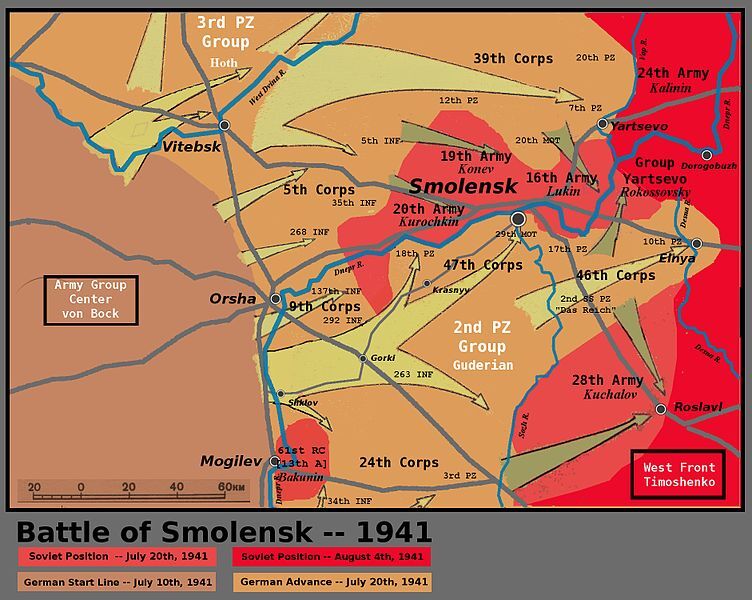
Map 2: The Battle of Smolensk
Guderian's salient is the deepest German penetration pictured here. Diagram by Livedawg via Wikimedia Commons.
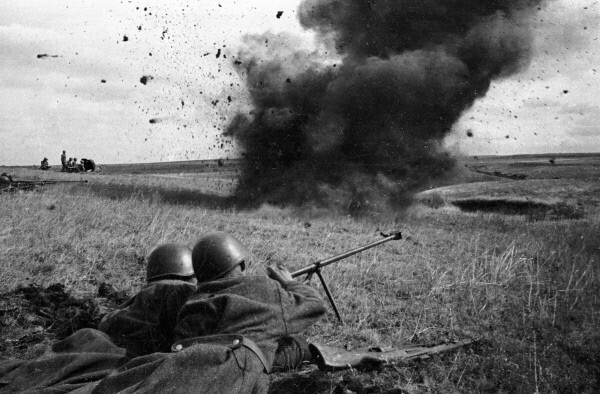
PTRD-41 anti-tank gun
Source: RIA Novosti archive, image #4408 / N. Bode / CC-BY-SA 3.0, via Wikimedia Commons.
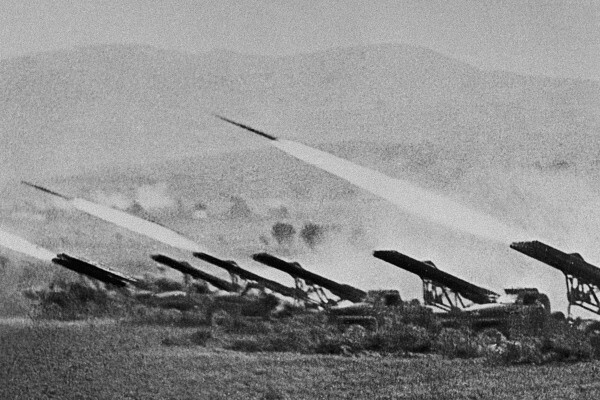
Stalin's organs: the Katyusha rocket launcher

Thank you for your support
I want to express my deep appreciation to all who supported Beyond Barbarossa in the start-up phase.
You can continue to support the costs of producing the podcast through Patreon.

Now available on Stitcher
In addition to the podcasting platforms across the header image, you can now also listen to Beyond Barbarossa on Stitcher.
Visit https://www.stitcher.com/show/beyond-barbarossa-eastern-front-of-world-war-ii.
From Blitzkrieg to Berlin
The eastern front was by far the largest part of the European theatre of World War Two. Yet compared to the Western Allies, there is little material available in English about the Soviets' fight. This podcast covers the history of the clash of two inimical tyrannies.
Music by Nicolas Bury
Sound effects obtained from https://www.zapsplat.com
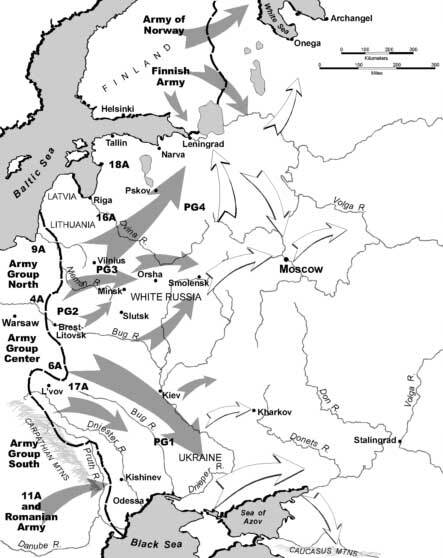
Operation Barbarossa: The plan
The German General Staff, OKW, planned Operation Barbarossa meticulously. The Wehrmacht, with support of the Luftwaffe, attacked in three main thrusts: Army Group North through the Baltic SSRs, Army Group Centre in two axes from the Bialystok Salient, that bulge just north of Brest-Litovsk, and Army Group South, into Ukraine.